Winter: My Secret
(by Christina Rossetti)
I tell my secret? No indeed, not I:
Perhaps some day, who knows?
But not today; it froze, and blows, and snows,
And you’re too curious: fie!
You want to hear it? well:
Only, my secret’s mine, and I won’t tell.
Or, after all, perhaps there’s none:
Suppose there is no secret after all,
But only just my fun.
Today’s a nipping day, a biting day;
In which one wants a shawl,
A veil, a cloak, and other wraps:
I cannot ope to everyone who taps,
And let the draughts come whistling thro’ my hall;
Come bounding and surrounding me,
Come buffeting, astounding me,
Nipping and clipping thro’ my wraps and all.
I wear my mask for warmth: who ever shows
His nose to Russian snows
To be pecked at by every wind that blows?
You would not peck? I thank you for good will,
Believe, but leave the truth untested still.
Spring’s an expansive time: yet I don’t trust
March with its peck of dust,
Nor April with its rainbow-crowned brief showers,
Nor even May, whose flowers
One frost may wither thro’ the sunless hours.
Perhaps some languid summer day,
When drowsy birds sing less and less,
And golden fruit is ripening to excess,
If there’s not too much sun nor too much cloud,
And the warm wind is neither still nor loud,
Perhaps my secret I may say,
Or you may guess.
Affichage des articles dont le libellé est pre-raphaelist. Afficher tous les articles
Affichage des articles dont le libellé est pre-raphaelist. Afficher tous les articles
mardi 12 février 2013

mercredi 12 décembre 2012
John Keats
« Ici repose celui dont le nom était écrit dans l’eau »
Poète du début du XIXème siècle, John Keats inspira le mouvement pré-préraphaélite dont ils ont les même influences, notamment le moyen-âge, Shakespeare et un amour de la nature.
Il est le symbole du romantisme que ce soit par ces personnages féminins, comme Isabella et La Belle Dame sans Merci, ou sa vie et sa personnalité attachante et douce.
Orphelin à 15 ans, il se chargera de ses frères et sœurs et veillera notamment avec abnégation sur son cadet atteint de la tuberculose. Il meurt finalement également de cette maladie... à 25 ans.
Il eut une vie brève mais passionnée qui lui vaudra la reconnaissance, malheureusement en grande partie posthume, de ses pairs.
Pour plus de détail une courte biographie.

Poète du début du XIXème siècle, John Keats inspira le mouvement pré-préraphaélite dont ils ont les même influences, notamment le moyen-âge, Shakespeare et un amour de la nature.
Il est le symbole du romantisme que ce soit par ces personnages féminins, comme Isabella et La Belle Dame sans Merci, ou sa vie et sa personnalité attachante et douce.
Orphelin à 15 ans, il se chargera de ses frères et sœurs et veillera notamment avec abnégation sur son cadet atteint de la tuberculose. Il meurt finalement également de cette maladie... à 25 ans.
Il eut une vie brève mais passionnée qui lui vaudra la reconnaissance, malheureusement en grande partie posthume, de ses pairs.
Pour plus de détail une courte biographie.
Bright Star

Bright star, would I were steadfast as thou art -
Not in lone splendour hung aloft the night
And watching, with eternal lids apart,
Like Nature's patient, sleepless Eremite,
The moving waters at their priestlike task
Of pure ablution round earth's human shores,
Or gazing on the new soft-fallen mask
Of snow upon the mountains and the moors -
No - yet still stedfast, still unchangeable,
Pillow'd upon my fair love's ripening breast,
To feel for ever its soft fall and swell,
Awake for ever in a sweet unrest,
Still, still to hear her tender-taken breath,
And so live ever - or else swoon to death.
Not in lone splendour hung aloft the night
And watching, with eternal lids apart,
Like Nature's patient, sleepless Eremite,
The moving waters at their priestlike task
Of pure ablution round earth's human shores,
Or gazing on the new soft-fallen mask
Of snow upon the mountains and the moors -
No - yet still stedfast, still unchangeable,
Pillow'd upon my fair love's ripening breast,
To feel for ever its soft fall and swell,
Awake for ever in a sweet unrest,
Still, still to hear her tender-taken breath,
And so live ever - or else swoon to death.
La Belle Dame Sans Merci
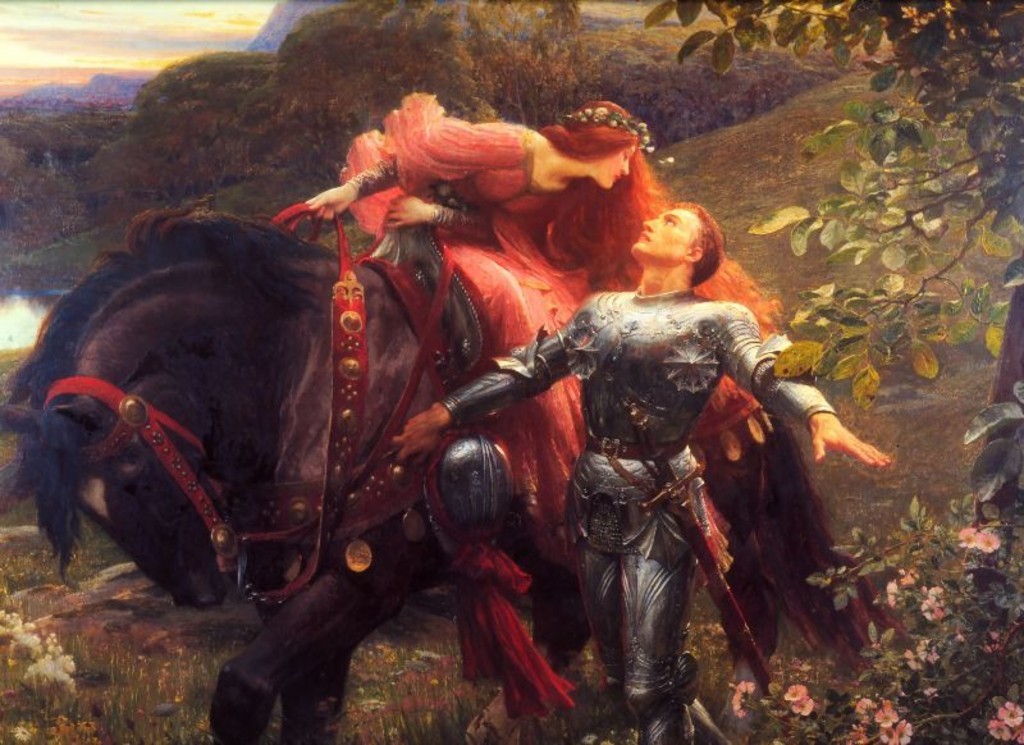 |
| La Belle Dame sans merci, 1890, Gabriel Dante Rossetti |
IV.
I met a
lady in the meads,
Full beautiful - a faery’s child,
Her hair was long, her foot was light,
And her eyes were wild.
Full beautiful - a faery’s child,
Her hair was long, her foot was light,
And her eyes were wild.
V.
I made a
garland for her head,
And bracelets too, and fragrant zone;
She look’d at me as she did love,
And made sweet moan.
And bracelets too, and fragrant zone;
She look’d at me as she did love,
And made sweet moan.
VI.
I set her
on my pacing steed,
And nothing else saw all day long,
For sidelong would she bend, and sing
A faery’s song.
And nothing else saw all day long,
For sidelong would she bend, and sing
A faery’s song.
VII.
She found
me roots of relish sweet,
And honey wild, and manna dew,
And sure in language strange she said -
«I love thee true.»
And honey wild, and manna dew,
And sure in language strange she said -
«I love thee true.»
VIII.
She took me
to her elfin grot,
And there she wept, and sigh’d fill sore,
And there I shut her wild wild eyes
With kisses four.
And there she wept, and sigh’d fill sore,
And there I shut her wild wild eyes
With kisses four.
Endymion
Book I
A THING of beauty is a joy for ever:
Its loveliness increases; it will never
Pass into nothingness; but still will keep
A bower quiet for us, and a sleep
Full of sweet dreams, and health, and quiet breathing.[...]
A THING of beauty is a joy for ever:
Its loveliness increases; it will never
Pass into nothingness; but still will keep
A bower quiet for us, and a sleep
Full of sweet dreams, and health, and quiet breathing.[...]
Isabella or The Pot of Basil A Story from Boccaccio
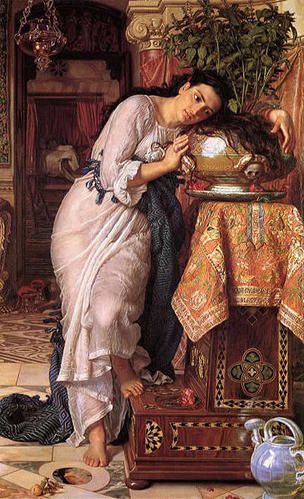 |
| Isabella and the Pot of Basil, 1867, William Holman Hunt |
LIII.
And she forgot the stars, the moon, and sun,
And she forgot the blue above the trees,
And she forgot the dells where waters run,
And she forgot the chilly autumn breeze;
She had no knowledge when the day was done,
And the new morn she saw not: but in peace
Hung over her sweet Basil evermore,
And moisten’d it with tears unto the core.
And she forgot the stars, the moon, and sun,
And she forgot the blue above the trees,
And she forgot the dells where waters run,
And she forgot the chilly autumn breeze;
She had no knowledge when the day was done,
And the new morn she saw not: but in peace
Hung over her sweet Basil evermore,
And moisten’d it with tears unto the core.
dimanche 9 décembre 2012
Ophélia
Autre thème privilégié des préraphaélites, la littérature...
Notamment Shakespeare... et un de ses personnages féminins les plus emblématiques et tragiques :
Notamment Shakespeare... et un de ses personnages féminins les plus emblématiques et tragiques :
Ophélia... L’infortuné amoureuse d’Hamlet qui
perdra l’esprit et se suicidera après que celui-ci l’ai non seulement délaissé
mais également tué son père.
 |
| Ophelia, John Everett Millais, 1852 |
 |
John William Waterhouse, Ophelia, 1889
[....] Sur l'onde calme et noire où dorment les étoiles
La blanche Ophélia flotte comme un grand lys, Flotte très lentement, couchée en ses longs voiles... - On entend dans les bois lointains des hallalis.[....]
Arthur Rimbaud
|
 | |
| John William Waterhouse, Ophelia, 1894 |
 |
Hamlet and Ophelia, Dante Gabriel Rossetti, 1858
|
samedi 8 décembre 2012
The lady of Shalott
Le thème du moyen-âge est un thème privilégié et récurrent
chez les préraphaélites.
Notamment la geste Arthurienne et l’histoire des chevaliers
de la table ronde qui offrent aux peintres nombres de légendes et épisodes
épiques ou amoureux propres à enflammer leur imagination.
La dame de Shalott est un de ces personnages du mythe
arthurien.
On ne compte pas moins de 3 tableaux de Waterhouse sur ce
thème, un de Hunt, et un de Grimshaw. Et ne nombreux autres artistes se sont
laissés envouter par la tragique histoire de la belle.
D'après la légende, la jeune femme ne pouvait regarder
directement la réalité du monde extérieur ; elle était condamnée à
observer à travers un miroir passant ses journées à broder ce qu'elle voyait
sur une tapisserie. Son désespoir se fit encore plus grand lorsqu’elle tomba
amoureuse du reflet de Lancelot et voulu rejoindre Camelot…
La malédiction fit qu’elle périt dans l’embarcation qui la menait vers la cité.
La malédiction fit qu’elle périt dans l’embarcation qui la menait vers la cité.
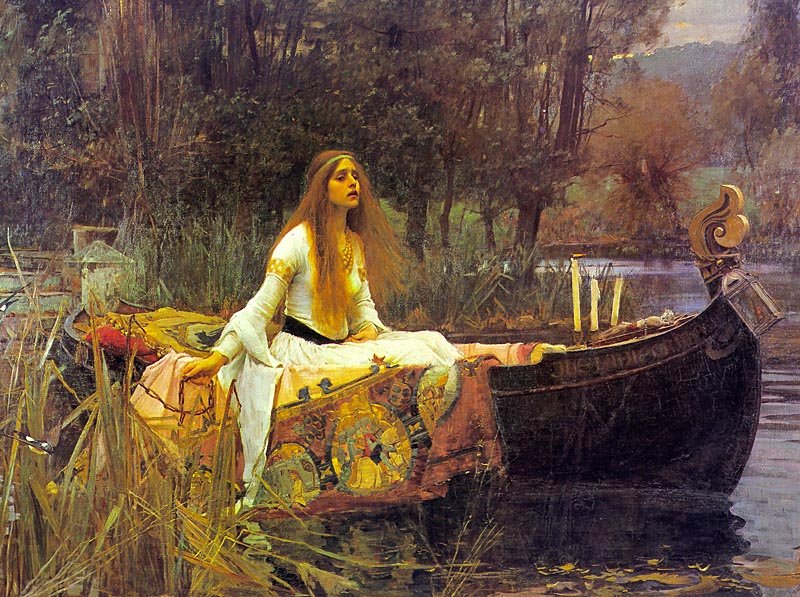 |
| John William Waterhouse's The Lady of Shalott, 1888 |
« And down the river's dim expanse
Like some bold seer in a trance,
Seeing all his own mischance
-- With a glassy countenance
Did she look to Camelot.
And at the closing of the day She loosed the chain, and down she lay;
The broad stream bore her far away, The Lady of Shalott …»
— Lord Alfred Tennyson, Extrait de la IVe partie
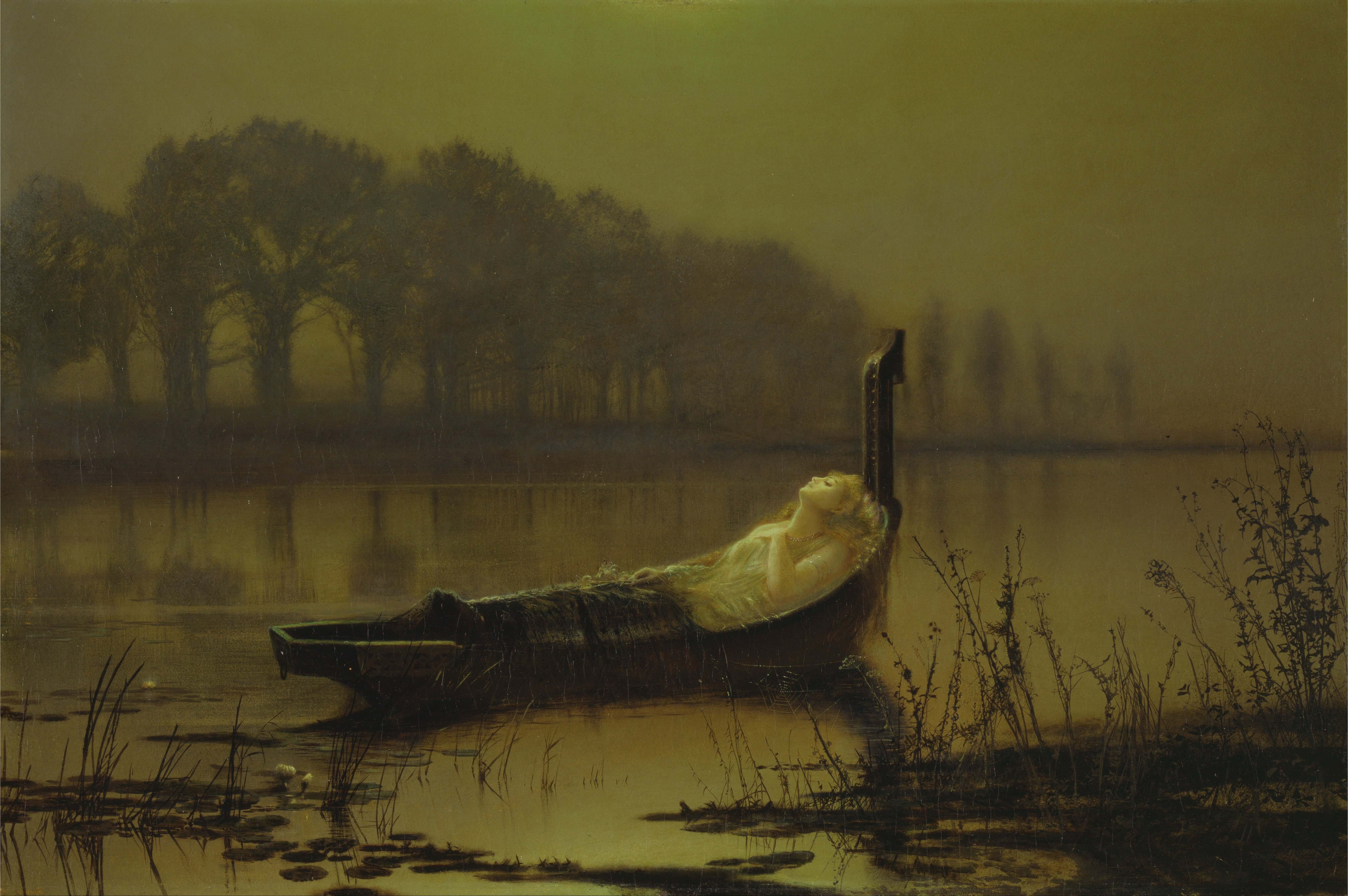 |
| John Atkinson Grimshaw's "The Lady of Shalott" 1875 |
 |
| William Holman Hunt's The Lady of Shalott 1905 |
 |
| Arthur Hughes's lady of Shalott 1873 |
Inscription à :
Articles (Atom)